Shock absorbers do their job in the background every time you drive, so you rarely think about them until something feels wrong. The problem is that wear is gradual. A car with tired shocks does not suddenly fall apart. It simply becomes a little less stable, a little slower to stop and a little less comfortable each month, and most drivers adjust without realising it.
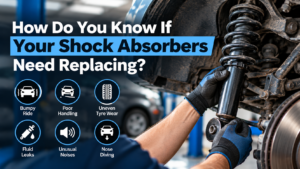
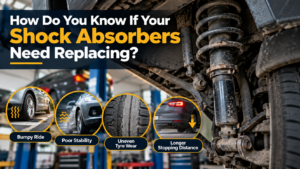
So how do you know if your shock absorbers need replacing? The main signs are a bouncy or floaty ride, the front of the car dipping when you brake, swaying in corners, uneven tyre wear, knocking noises over bumps, vibration through the steering wheel and oily fluid on the shock body. Any one of these is worth investigating, and two or more together usually mean the shocks are past their best.
In this guide we explain what each sign means, how to run simple checks yourself in a few minutes, what worn shocks do to your braking and tyres, and how often they should be inspected. If you would rather have a professional look at it, our suspension and shock absorber repairs service is carried out by a mobile mechanic who comes to you.
What Do Shock Absorbers Actually Do?
Your springs absorb the energy from bumps and potholes, but a spring left on its own would keep bouncing long after the bump has gone. A shock absorber is a hydraulic damper that controls that movement. As the suspension compresses and extends, oil inside the shock is forced through tiny valves, which turns the movement into heat and settles the wheel quickly.
The result is that your tyres stay in firm contact with the tarmac. That contact is what you rely on for steering, braking and cornering grip, so shocks play a bigger part in your safety than their quiet role suggests. On many cars the shock and spring are combined into a single strut, and the same warning signs apply, so when we say shock absorbers in this guide, struts are included.
Because they work constantly, over thousands of miles the seals wear, the oil breaks down and the valves lose their ability to control movement. Town traffic, speed bumps, coastal roads and seasonal pothole damage all speed up for drivers in and around Bournemouth.
The Main Signs Your Shock Absorbers Need Replacing
Worn shocks tend to announce themselves in several ways. You may notice one or two at first, and more appear as the wear progresses.
A bouncy or floaty ride
After a bump, a healthy car settles almost immediately. If yours keeps rolling or bobbing, especially over speed bumps or uneven surfaces, the damping has weakened. This is usually the first thing drivers notice, and it is often easiest to feel on a longer drive.
Nose diving when you brake
When you brake firmly and the front of the car dips sharply, the front shocks are no longer controlling the weight transfer. This can lengthen your stopping distance, so it is one of the signs to take most seriously. If the car also feels unsettled or pulls under braking, it is worth having the brake repairs and replacement side checked at the same time, because the two systems work closely together.
Rear squat when accelerating
The opposite can happen at the back. The rear drops noticeably when you pull away and the front lifts slightly, as if the car is sitting back on its haunches. This points to tired rear shocks and can be uncomfortable for passengers.
Swaying and rolling in corners
If the body leans heavily through roundabouts and bends, or crosswinds push the car around on faster roads, the shocks are not holding the body steady. The steering can feel vague and you may find yourself correcting more often than you used to.
Uneven tyre wear
When a shock is weak, the tyre bounces slightly on the road instead of rolling smoothly. Over time this leaves patches of wear, often called cupping or scalloping, which you can feel as a rhythmic hum and see as scooped sections of tread. Uneven wear can also come from alignment or pressure issues, so mention it when you book a full or interim service and let the mechanic check the cause.
Knocking or clunking noises
A dull knock over bumps can mean the shock is bottoming out, or that the mounts and bushes around it have worn. Either way the fault is in the suspension and should be inspected rather than ignored.
Steering wheel vibration
Some vibration on rough surfaces is normal. Vibration or shimmy on smooth roads can point to worn shocks or struts, although tyre balance and wheel bearings can cause similar symptoms, which is why a proper inspection matters.
Oil leaking from the shock
Look at the body of the shock. A light film of dust is normal, but wet, oily residue running down the barrel means the seal has failed and the shock has lost fluid. A leaking shock cannot control the suspension properly and needs replacing.
Simple Checks You Can Do at Home
You do not need tools to get a useful idea of the condition of your shocks.
The bounce test is the classic. Park on level ground, stand beside one corner of the car and push down firmly on the wing a few times to get it moving, then let go. A healthy shock settles within one bounce, or two at most. If the car keeps bouncing three times or more, that corner is likely worn. Repeat the test at every corner, because shocks do not always wear evenly.
Next, carry out a visual inspection. With the car parked safely, look behind each wheel at the shock or strut body for oil, damp patches or heavy corrosion, and check the rubber boots and mounts for splits or cracks. A torch helps. Then take a short drive along a road you know well with the radio off, listen for knocks over bumps, and pay attention to how the car behaves when you brake and corner.
These checks are a guide, not a diagnosis. A bounce test can miss early wear, and noises can come from other suspension parts such as drop links, bushes or springs. If a warning light has also appeared on your dashboard, our vehicle diagnostic service can help rule out related faults, and our guide on what a car engine warning light really means explains what to do next.
Why Worn Shock Absorbers Are a Safety Issue
It is tempting to put up with a rough ride, and slightly worn shocks will not necessarily stop you driving. But the effects go well beyond comfort. When the tyres lose consistent contact with the road, braking distances increase, particularly on wet surfaces, which are common on the south coast. Emergency manoeuvres become less stable, and the car is more easily affected by crosswinds and sudden steering inputs.
Worn shocks also put extra strain on the rest of the car. Tyres wear faster and unevenly, while springs, mounts, bushes and braking components all work harder than they should. Leaving the problem alone often means more parts need attention later, which is why early replacement is the sensible route.
There is an MOT angle too. A shock absorber that is leaking or no longer working effectively can be recorded as a defect, and in some cases it leads to a failure. If you notice nose diving, longer stopping distances or unstable steering, treat them as reasons to book an inspection soon rather than waiting for your next service.
How Often Should Shock Absorbers Be Checked?
There is no single mileage that suits every car, because shock life depends heavily on how and where the car is used. Different sources give different intervals, with some suggesting a check every 20,000 miles and others a first inspection at around 50,000 miles followed by a yearly check. Many shocks last somewhere between 50,000 and 100,000 miles, and some need attention sooner. A look at every service, plus an annual inspection once the car passes 50,000 miles, is a sensible habit.
Several things shorten their life. Regularly driving over potholes, speed bumps and rough lanes is the biggest factor, followed by carrying heavy loads or towing, driving hard into corners and making lots of short journeys on poor surfaces. Slowing down for speed bumps, avoiding overloading and keeping tyres at the correct pressure are the easiest ways to help them last. Having the suspension looked at during your full or interim service means wear is caught while it is still manageable, and it is just as useful before a holiday, as we explain in our guide to preparing your car for a long journey from Bournemouth.
Replacing Shock Absorbers: What You Should Know
Shock absorbers should always be replaced in pairs, meaning both fronts or both rears together. A new shock fitted next to an old one gives uneven damping across the axle, which affects handling and can wear the new unit faster. If the whole set is old, replacing all four is worth considering, and your mechanic can advise based on the condition of each one.
Struts need extra care. Many cars use coil springs held under heavy compression, and removing them without a spring compressor and the right experience is dangerous. Incorrect fitting or wrong torque settings can leave a car with poor braking or steering control, which is why we recommend leaving the job to a professional rather than attempting it on the driveway. Afterwards, a wheel alignment check is often advisable, because the suspension geometry can change when parts are removed.
Because we are a mobile service, the work can be carried out at your home or workplace, so you do not need to arrange a garage drop off. If you are not sure whether that suits your situation, read our guide on when to call a mobile mechanic in Bournemouth. After the new shocks go on, a short test drive makes the difference obvious: the car feels planted, settles quickly over bumps and stops in a straighter line.
Frequently Asked Questions
Can I still drive with worn shock absorbers?
Slightly worn shocks will not always stop the car from moving, but they reduce grip, lengthen stopping distances and make rough roads harder to handle. The more obvious the symptoms, the less sensible it is to keep driving on them, particularly at speed or in wet weather.
How long do shock absorbers last?
Many last between 50,000 and 100,000 miles, but road quality, driving style and load all change that. Wear is so gradual that regular inspection is a better guide than mileage alone.
Can I replace just one shock absorber?
It is best not to. Shocks should be replaced in pairs on the same axle so the damping stays balanced from side to side.
What does a bad shock absorber sound like?
Typically a clunk or knock when driving over bumps, which can come from the shock bottoming out or from worn mounts and bushes. A rattle from the corner of the car that was not there before is always worth checking.
Can worn shock absorbers fail an MOT?
They can. Leaking or ineffective shock absorbers can be recorded as a defect, and the severity decides whether it is an advisory or a failure.
Who can check my suspension without me taking the car to a garage?
Our mobile mechanic can inspect and repair your suspension at your location. You can learn more about our work on the about page or browse the frequently asked questions page.
Final Thoughts
Knowing how to spot worn shock absorbers is one of the simplest ways to protect your safety and your tyres. A bouncy ride, nose diving under braking, swaying in corners, uneven tyre wear, knocking noises, steering vibration and oil on the shock body are all clear signals, and the bounce test gives you a quick way to confirm your suspicions at home.
If your car is showing any of these signs, do not wait for it to get worse. Contact us to arrange a suspension inspection, or visit our suspension and shock absorber repairs page to see how we can help, wherever your car is parked in Bournemouth.