That small engine shaped symbol lighting up on your dashboard has a way of making your stomach drop. One moment you are driving along the Wessex Way or sat in traffic near Bournemouth Square, the next you are wondering whether the car is about to break down.
The good news is that an engine warning light is not always an emergency. The less comfortable news is that it should never be ignored. This guide explains what the light actually means, how to read what it is telling you, the most common causes, and exactly what to do next.
At Mechanic Bournemouth, our fully qualified, IMI accredited mechanics have been helping drivers across Bournemouth, Poole, Christchurch and the wider Dorset area for over 15 years, so this is a question we answer every week.
Quick Answer: What Does the Engine Warning Light Mean?
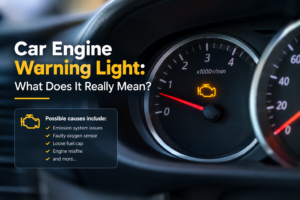
The engine warning light, also called the check engine light or engine management light, comes on when your car’s computer has found a fault in the engine, the emissions system or a related component. It does not tell you what the fault is. It tells you that something needs to be properly checked.
| What you see | What it usually means | What to do |
| Solid amber or orange | A fault has been detected | Drive carefully and book a diagnostic check soon |
| Flashing amber or orange | A serious problem is happening now, often a misfire | Reduce speed, stop when safe and get help |
| Red | A severe issue such as low oil pressure or overheating | Stop as soon as it is safe and switch off |
What Is the Engine Warning Light?
Every modern car has an Engine Control Unit, usually called the ECU. It is the car’s main computer, and it constantly reads data from dozens of sensors monitoring the engine, fuel system, exhaust and, in many cars, the transmission.
When a sensor reports a reading outside the expected range, the ECU stores a fault code and switches on the warning light. The official name for the light is the Malfunction Indicator Lamp, or MIL.
How it differs from other dashboard lights
The engine light is not the same as your oil pressure light, coolant temperature light or battery light. Those are separate warnings with their own symbols and their own urgency. If more than one light appears at the same time, tell your mechanic, because it helps narrow down the cause.
When it is perfectly normal
It is normal for the engine light to appear briefly when you switch the ignition on and then disappear once the engine starts. That is the car running a quick self test. It only becomes a concern if the light stays on or returns while you drive.
Solid, Flashing or Red: Reading the Signal
A solid amber or orange light
This is the most common situation. The ECU has stored a fault that is present or has recently occurred. The car may feel completely normal, which is exactly why so many drivers put it off.
A solid light is not a reason to panic, but it is a reason to act. A sensor reporting poor data can leave the engine running with the wrong balance of fuel and air, which puts extra strain on parts such as the spark plugs and the catalytic converter over time.
A flashing amber or orange light
A flashing light is the car raising its voice. It usually signals a misfire severe enough that unburnt fuel may be entering the exhaust, where it can overheat and damage the catalytic converter. You may also notice shaking, hesitation, a sudden loss of power or a strong smell of fuel.
If the light is flashing, do not try to limp home. Ease off the accelerator, avoid heavy loads and stop somewhere safe. Continuing to drive can turn a repairable fault into major engine damage.
A red warning light
Some manufacturers use red for their most serious engine warnings. A red engine light, or a red oil or temperature warning, means you should stop as soon as it is safe. Common causes include very low oil level, low oil pressure, overheating and major engine faults. Even a short distance can cause serious harm, so switch off the engine and call for assistance.
Can You Keep Driving With the Engine Light On?
It depends on what the light is doing and how the car feels.
You can usually continue with care if
- The light is solid, not flashing
- The car drives normally with no loss of power
- There are no strange noises, smells or smoke
- No red warning lights are showing
Even then, keep your speed moderate, avoid towing or hard acceleration, and arrange a diagnostic check as soon as you can.
You should stop driving if
- The light is flashing or red
- The engine is shaking, stalling or losing power
- You can smell burning or fuel
- You see smoke from the bonnet or exhaust
- The temperature gauge is climbing
When in doubt, stopping is always the safer choice.
What to Do When the Engine Light Comes On
Stay calm and work through these steps in order.
- Note how the light is behaving. Solid or flashing? Amber or red? This one detail tells you how urgent things are.
- Notice how the car feels. Listen for knocking, sputtering or hissing. Look out for vibration, rough idling, hesitation or reduced power, and check for any other warning lights.
- Check the fuel cap. When safely parked, make sure it is fitted properly and tightened until it clicks. A loose or damaged cap can break the seal on the fuel system and trigger the light. If that was the cause, the light may clear itself after a few days of normal driving.
- Ease the load on the engine. Drive gently, avoid high revs and heavy loads, and keep journeys short until the car has been checked.
- Book a proper diagnostic check. This is the only reliable way to find out what the car is trying to tell you.
The Most Common Causes of an Engine Warning Light
There are hundreds of possible fault codes, but a handful of causes account for most call outs.
1. A loose, cracked or missing fuel cap
It sounds too simple to be true, but it is one of the most frequent causes. The fuel system is sealed so that petrol vapour cannot escape. If the cap does not seal, the system detects a leak in the evaporative emissions circuit and raises a fault.
2. A failing oxygen sensor
Oxygen sensors sit in the exhaust and measure how much unburnt oxygen is leaving the engine. The ECU uses this to fine tune the fuel and air mixture. When a sensor becomes lazy or fails, the engine can run too rich or too lean, which affects performance, fuel economy and emissions, and can shorten the life of the catalytic converter.
3. Worn spark plugs or failing ignition coils
Spark plugs ignite the fuel and air mixture in each cylinder, and ignition coils supply the electrical energy to do it. When either wears out, the engine can misfire. You might feel it as juddering, poor acceleration, rough idling or difficulty starting. A misfire is one of the main reasons for a flashing engine light.
4. A faulty mass airflow sensor
This sensor measures how much air enters the engine. If it becomes dirty or fails, the ECU cannot balance the mixture correctly. Symptoms include stalling, hesitation, rough running and reduced performance.
5. A failing catalytic converter
The catalytic converter turns harmful exhaust gases into less harmful emissions. It rarely fails on its own. More often it is damaged by an underlying issue that was ignored, such as a misfire, a faulty oxygen sensor or an oil or coolant leak. This is one of the strongest reasons to investigate a warning light early.
6. Diesel particulate filter problems
On diesel cars, the particulate filter traps soot and burns it off during longer runs. Cars used mainly for short journeys around town can struggle to complete this cleaning process, which leads to a blocked filter and a warning light. If that sounds familiar, mention your driving habits to your mechanic.
7. EGR valve faults
The exhaust gas recirculation valve feeds a small amount of exhaust back into the engine to reduce emissions. Carbon build up can make it stick, causing rough running, poor performance and a lit warning light.
8. Vacuum leaks and wiring faults
A split hose or a loose connection can let unmetered air into the engine or interrupt a sensor signal. These faults are hard to spot without proper equipment, and they are a common reason a light returns after a quick fix.
9. Battery and electrical issues
A weak battery or charging problem can cause voltage fluctuations that confuse sensors and trigger fault codes. If the battery has been disconnected or replaced recently, the car may also need time to relearn its settings. Our team can test and replace your car battery at your home or workplace.
10. Clutch, gearbox and other sensor faults
Modern cars monitor far more than the engine alone. A slipping clutch, a transmission sensor fault or a problem with the AdBlue system on some diesels can all bring on the engine light.
Why Reading the Code Is Only the Start
Every modern car has an OBD port, normally located under the dashboard near the driver’s knees. A diagnostic scanner plugged into this port reads the stored Diagnostic Trouble Codes, which look like P0301 or P0420.
Here is the part many drivers miss: a fault code is a symptom, not a diagnosis.
A code pointing at an oxygen sensor does not automatically mean the sensor is faulty. The real cause could be an exhaust leak, a wiring problem or a fuel mixture issue upstream. Replacing parts based on a code alone often means the light returns within days.
A proper car diagnostic check involves reading the codes, viewing live sensor data, inspecting the related components and testing to confirm the root cause before any repair begins. That approach fixes the actual problem once, rather than chasing it repeatedly.
Can You Just Reset the Light?
It is tempting to clear the code with a basic reader or by disconnecting the battery. Here is why that is rarely a good idea.
- The fault is still there. Clearing a code repairs nothing. If the problem remains, the light will return.
- You lose valuable information. Stored codes and freeze frame data show a technician exactly what was happening when the fault occurred.
- It can affect your MOT. Recently cleared codes can leave the emissions monitors in a not ready state, which can cause problems at test time.
- Some lights clear on their own, but the record stays. If a fault was temporary, such as a loose fuel cap, the light may switch off after several drive cycles. The stored history can still be read by a technician.
The best approach is to have the fault diagnosed and repaired. Once the issue is resolved, the light goes out as it should.
Will an Engine Warning Light Fail Your MOT?
In most cases, yes. An illuminated engine management light is treated as a major defect in the MOT test, which means an automatic fail. Older vehicles fall outside this check. Petrol cars first registered before 1 July 2003 and diesel cars first registered before 1 July 2008 are exempt from this part of the test.
If your MOT is approaching and the light is on, get it diagnosed and repaired first. Turning up to the test with an active warning is the quickest route to a fail sheet and a retest.
Why Ignoring the Light Makes Things Worse
Putting off a diagnosis rarely makes the problem disappear. Here is what typically happens:
- A minor sensor fault leads to a poor fuel mixture, which strains the spark plugs and catalytic converter
- A small misfire develops into overheating in the exhaust system
- Reduced efficiency and rougher running become part of your daily drive
- A repair that could have been straightforward turns into a larger job involving several components
- The risk of a sudden breakdown, possibly somewhere inconvenient, goes up
Acting early is simply the more sensible route for your car and your peace of mind.
Why a Mobile Mechanic Makes Sense for Engine Light Diagnostics
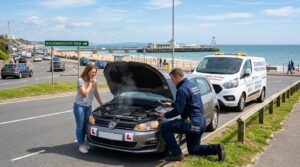
If your car is running rough or the light is flashing, the last thing you want is to drive it to a garage. A mobile mechanic brings the workshop to you, whether you are at home in Bournemouth, at the office, or stuck at the roadside.
A qualified mobile mechanic can:
- Connect professional diagnostic equipment on site
- Read and interpret fault codes and live sensor data
- Inspect likely causes such as spark plugs, coils, sensors, hoses and wiring
- Explain clearly what is wrong and what needs doing
- Carry out many common repairs at your location
That saves time, avoids the risk of driving a poorly car and keeps your day moving. If you are unsure whether your situation calls for a visit, our guide on when you should call a mobile mechanic in Bournemouth explains exactly when it makes sense.
How to Reduce the Chances of the Light Returning
You cannot prevent every fault, but good habits make a real difference.
- Keep up with regular servicing. Fresh oil, clean filters and spark plugs replaced at the right intervals protect the whole engine. Our car servicing covers all of this.
- Tighten the fuel cap after every fill up. It takes a second and avoids an annoying false alarm.
- Use decent quality fuel and avoid running the tank close to empty.
- Give diesels a proper run. An occasional longer drive at a steady speed helps the particulate filter clean itself.
- Address small symptoms early. Rough idling, a hesitant pull away or a slightly thirstier car are all early hints.
- Do not overlook timing components. Worn belts and related parts can cause serious engine trouble, so read our advice on cambelt and water pump replacement if your car is approaching its service interval.
Frequently Asked Questions
What does an engine warning light mean in simple terms?
It means your car’s computer has detected a fault in the engine, exhaust or a related system and stored a code. You need a diagnostic check to find out exactly what it is.
Is it safe to drive with the engine light on?
If it is solid and the car drives normally, you can usually continue carefully to arrange a check. If it is flashing or red, or the car is shaking, losing power or smoking, stop safely and get help.
Why is my engine light on but the car feels fine?
Many faults, especially sensor issues, do not change how the car drives at first. The fault still needs attention because it can develop into something more serious.
Why did my engine light come on and then go off?
Some faults are intermittent, such as a loose fuel cap or a sensor that misreads occasionally. The car still stores the code, so it is worth having it read.
Can a loose fuel cap really cause the engine light?
Yes. It is one of the most common triggers. Tighten it until it clicks and drive normally. If the light does not clear within a few days, get the car checked.
What is the difference between the engine light and the oil light?
The engine light relates to engine management and emissions. The oil light warns about oil pressure or level, which is usually more urgent and often shown in red.
Will the engine light fail an MOT?
Yes, for most vehicles it is a major defect. Only older petrol cars registered before July 2003 and diesel cars registered before July 2008 are exempt from this check.
Can I clear the light myself?
You can clear codes with a reader, but it does not fix the problem and the light will usually return. It can also erase useful diagnostic data.
How long does an engine light diagnostic take?
Reading the codes is quick, but a thorough diagnosis that confirms the root cause takes longer. The time depends on the fault and the vehicle.
Engine Light On in Bournemouth? Let Us Take a Look
An engine warning light is your car asking for attention. Whether it is a simple fault or something more involved, the sooner it is properly diagnosed, the easier it is to put right.
At Mechanic Bournemouth, we find the real cause and explain everything in plain English, either at our workshop or through our mobile mechanic service at your home or workplace. Contact us today to book a diagnostic check and get back on the road with confidence.