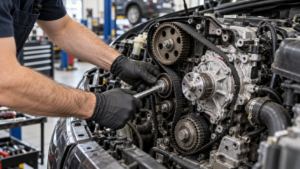
The short answer is yes, in most cases. If your water pump is driven by the cambelt, you should replace both parts in the same visit. The mechanic has to remove the cambelt to reach the pump, so the extra work is small. Splitting the jobs means paying for the same lengthy repair twice, and a worn pump left in place can damage a brand new belt, or the engine itself.
This guide explains why the two parts are linked, what happens if you replace only one, the warning signs to watch for, and the rare cases where you can leave the pump alone. If you are a driver in Bournemouth, Poole or Christchurch, it will help you decide with confidence.
What Does a Cambelt Do?
The cambelt, also called the timing belt, is a toothed rubber belt inside your engine. Its job is to keep the crankshaft and the camshaft turning in perfect step. That timing decides when the valves open and close in relation to the pistons.
The belt is made from reinforced rubber and wears with age and mileage, even if the car is rarely driven. When it snaps or slips, the timing is lost instantly. On many modern engines, known as interference engines, the pistons and valves then collide. The result can be bent valves, damaged pistons and, in serious cases, a ruined engine.
What Does the Water Pump Do?
The water pump circulates coolant around the engine and through the radiator and heater matrix. Without that flow, the engine overheats within minutes. It contains a bearing and an impeller, and both wear over time. A failing pump can leak coolant, whine, seize or stop circulating fluid altogether.
Why Are the Cambelt and Water Pump Linked?
There are three practical reasons the two parts are treated as a pair.
1. On many engines, the cambelt drives the water pump.
The pump takes its power from the same belt that keeps the engine timed. If the pump bearing fails or the pump seizes, it can drag on the belt, making it jump teeth or snap. In other words, a faulty pump can destroy a healthy belt.
2. The pump sits behind the same components.
To reach the pump, a mechanic normally has to remove the cambelt, the tensioner, the pulleys and the covers first. That is the majority of the labour. Once those parts are out, changing the pump is a short extra step, while doing it later means stripping the same area of the engine all over again.
3. Both parts wear at a similar rate.
Cambelts and water pumps are usually designed with comparable service lives. If one has reached the end of its interval, the other is close behind. Replacing them together resets the whole system in one go.
What Happens If You Replace Only the Cambelt?
Fitting a new belt but keeping a tired pump is a gamble. A pump with a worn bearing can fail a few thousand miles later, and you are back at the start with the same engine strip down. Worse, the failing pump can seize and take the new belt with it.
Coolant leaks are another risk. Even a small seep at the pump seal can lower the coolant level, reduce cooling efficiency and, over time, lead to overheating. Because the pump is often hidden behind the belt cover, the early signs are easy to miss.
What Happens If You Replace Only the Water Pump?
The opposite mistake is just as risky. If the pump is being changed and the belt is already in the second half of its life, the belt is exposed and accessible right at that moment. Leaving it in place means a working pump and an old belt that could still snap without warning. If your pump is being replaced on a belt driven engine and the belt has any real age or mileage behind it, replace both.
What Is Included in a Full Cambelt and Water Pump Kit?
A proper job replaces the whole timing system, not just two parts. A typical kit includes:
- The cambelt
- The tensioner
- Idler pulleys
- The water pump
- Fresh coolant to refill the system
- On some engines, the auxiliary (drive) belt, thermostat and seals
Replacing the tensioner and pulleys matters because they wear at the same pace as the belt. A new belt running over an old, noisy pulley is a false economy in reliability terms. Good mechanics also use quality parts that match the manufacturer’s specification.
Can a Bad Water Pump Break the Cambelt?
Yes. When a belt driven pump stops turning, seizes or has a bearing collapse, it can shred the belt or knock it off its teeth. On an interference engine, that is enough to cause valve and piston damage. This is the single strongest reason mechanics refuse to fit a new cambelt without also changing the pump when the two are connected.
Warning Signs of a Failing Water Pump
Watch for these symptoms and get the car checked promptly:
- The temperature gauge climbs or the engine overheats
- Coolant leaks, often seen as puddles or dried residue near the front of the engine
- A whining, grinding or squealing noise from the belt area
- Low coolant that keeps needing topping up
- Steam from under the bonnet
- A weak or cold heater, which can point to poor circulation
Warning Signs Your Cambelt Is Due
Cambelts often give little warning before they fail, which is why the service interval matters so much. Symptoms that can appear include a ticking sound from the engine, rough running or misfires, difficulty starting, and oil leaking near the belt cover. If you notice any of these, stop driving and have the car inspected rather than waiting for the next service.
How Often Should a Cambelt Be Replaced?
There is no single figure. Manufacturers set their own intervals, and many fall somewhere between 40,000 and 100,000 miles or 4 to 10 years, whichever comes first. Age matters as much as distance, because rubber hardens with time even in a car that barely moves. Always follow your owner’s handbook and service history, and if you drive in short, stop start journeys, lean towards the shorter end of the range.
Cambelt or Timing Chain: Does Your Car Need This Job?
Not every engine has a cambelt. Many newer cars use a timing chain instead, which is built to last much longer and is not replaced on a fixed schedule. On those engines the water pump is often driven by a separate auxiliary belt or by an electric motor, so the advice above may not apply in the same way. Check your handbook, or ask a mechanic to confirm what your engine has before booking anything.
When Might You Not Need to Replace the Water Pump?
Being honest matters, and there are a few situations where replacing the pump at the same time is not essential:
- Your engine has a timing chain, or the pump is driven by another belt and is not behind the cambelt
- The pump was replaced recently, and you have the invoice to prove the date and mileage
- The pump is electric and sits away from the timing system
If none of those apply, treat the pump as part of the job. A mechanic can also inspect the pump for play, leaks and corrosion before you decide, but on a belt driven engine the safe recommendation is nearly always to change it.
Quick Comparison: Replace Together or Separately?
| Replaced together | Replaced separately | |
| Labour involved | One engine strip down | Two engine strip downs |
| Risk of pump damaging the belt | Removed | Remains |
| Risk of an old belt snapping | Removed | Remains if only the pump is changed |
| Time off the road | One visit | Two visits |
| Peace of mind | High | Low |
Buying a Used Car: Check the Cambelt History
If you are buying a second hand car, ask for proof of the last cambelt change. A missing record should be treated as if the job is overdue. Ask whether the water pump was changed at the same time, and if the paperwork is unclear, book a check before you commit. It is far better to know the position on day one than to discover it at the roadside.
What to Expect When You Book the Job
A cambelt and water pump replacement is a substantial repair, and it is often a matter of several hours, sometimes stretching towards a full working day depending on the vehicle. The coolant is drained, the old belt system is removed, the pump and kit are fitted, the timing is set to the manufacturer’s marks, and the system is refilled and checked for leaks.
A mobile mechanic can carry out this kind of work at your home or workplace, so you do not need to arrange a garage drop off. If you are unsure whether the job is due, our guide on when to call a mobile mechanic in Bournemouth explains which repairs suit a visit to your door.
Frequently Asked Questions
Should I replace the water pump when I change the cambelt?
Yes, if the pump is driven by the belt or sits behind it. It is the standard recommendation because the access work is already done.
Can I change the cambelt and leave the water pump?
You can, but you take on the risk of a second engine strip down and the chance that the old pump damages the new belt.
What happens if the water pump fails?
The engine can overheat quickly. On belt driven systems, a seized pump can also break the cambelt and cause serious internal engine damage.
Is the water pump part of the cambelt kit?
Some kits include it and some do not. Ask your mechanic exactly which parts are being replaced so nothing is missed.
Do all cars have a cambelt?
No. Many engines use a timing chain, which is not replaced on a set interval.
How long does the job take?
It varies by vehicle, but expect several hours and sometimes most of a day.
Should the thermostat and auxiliary belt be replaced too?
On many engines, it makes sense, as they are reached during the same job. Ask your mechanic what is recommended for your car.
Final Thoughts
For most belt driven engines, replacing the cambelt and water pump together is the sensible, safe choice. The parts work as a team, wear at a similar rate and share the same labour. Doing them at once protects your engine from one of the most serious failures a car can suffer, and it means you will not have to revisit this part of the engine for a long time.
If your car is approaching its cambelt interval, or you are not sure when the last change was done, get in touch with our Bournemouth mobile mechanic team for a straightforward check and advice.