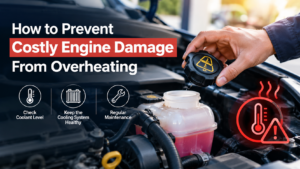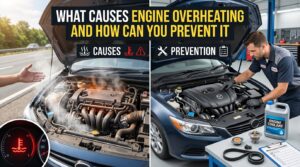
Engine overheating is almost always caused by a failure somewhere in the cooling system, most commonly low coolant, a stuck thermostat, a failing water pump, a blocked radiator, or a cooling fan that has stopped working. Preventing it comes down to checking coolant levels regularly, replacing worn hoses before they split, and having the cooling system inspected as part of your annual service. Mechanic Bournemouth sees overheating jobs cluster in two places, hot summer traffic along the A338 and long winter idling, and in most cases the warning signs were there weeks before the temperature gauge finally climbed.
How an Engine Cooling System Actually Keeps Temperature Down
Understanding why overheating happens is easier once you know what the system is doing. Coolant circulates through passages in the engine block, absorbing heat from combustion. The water pump keeps it moving. The thermostat decides when that hot coolant is allowed through to the radiator, where airflow carries the heat away. The cooling fan provides that airflow when the car is stationary or moving slowly.
Every overheating fault traces back to one of those four stages breaking down, and knowing which stage has failed is what a proper diagnosis establishes.
The Most Common Causes of Engine Overheating
Low coolant. The single most frequent cause. Coolant depletes slowly over time and drops fast if there’s a leak at a hose joint, the radiator, or the water pump seal. Without enough fluid in the system there simply isn’t enough capacity to carry heat away.
A faulty thermostat. Stuck closed, it traps hot coolant in the engine and temperature climbs rapidly, often within a few miles of setting off. Stuck open, the engine struggles to reach proper operating temperature, which hurts fuel efficiency and causes its own long term wear.
Water pump failure. The pump’s impeller can wear, corrode, or break. When circulation stops, heat builds in one place rather than spreading through the system. This one often shows up as overheating at idle or in slow traffic.
Radiator blockage or damage. Internal corrosion, scale build up, or external debris packed into the fins all reduce how much heat the radiator can shed. Cars driven regularly on coastal roads around Bournemouth and Poole pick up salt residue that accelerates radiator corrosion over time.
Cooling fan failure. Usually electrical, a blown fuse, a failed relay, or a dead fan motor. The symptom is distinctive: the car runs at normal temperature on the move but climbs the moment you stop in traffic, because there’s no airflow without the fan.
Head gasket failure. Less common but far more serious. A blown head gasket lets coolant escape into the combustion chambers or oil system, and it both causes overheating and results from it.
Not Sure Which Part of the Cooling System Has Failed?
Guessing at an overheating fault usually means replacing parts that were fine. Mechanic Bournemouth’s vehicle diagnostic service pressure tests the cooling system and reads the temperature sensor data directly, which narrows it down to the actual failing component before any work starts. It’s a quicker route to an answer than swapping a thermostat and hoping.
Warning Signs Your Engine Is About to Overheat
| Warning Sign | What It Usually Points To |
| Temperature gauge creeping above normal | Early coolant loss or a thermostat starting to stick |
| Sweet syrupy smell around the car | Coolant leaking onto hot engine components |
| Heater blowing cold when the engine is warm | Low coolant level or an air pocket in the system |
| Overheats only in traffic, fine on the move | Cooling fan or radiator airflow problem |
| White smoke from the exhaust | Coolant entering the combustion chambers, possible head gasket |
| Visible puddle under the parked car | Hose, radiator, or water pump seal leak |
The heater test in that table is worth knowing. The cabin heater draws heat from the same coolant circuit, so if it blows cold while the engine is hot, coolant isn’t circulating properly. It’s often the earliest symptom a driver actually notices.
What to Do the Moment Your Car Starts Overheating
Pull over somewhere safe as soon as you can and switch the engine off. On a dual carriageway, leave at the next exit rather than stopping on the hard shoulder if you have the option. Switch on hazard lights and get passengers out and away from the road.
Leave the bonnet closed if there’s steam pouring out, and wait at least thirty minutes before touching anything. Never open the radiator cap or expansion tank cap on a hot engine. The system is pressurised and releasing it releases scalding coolant and steam. Once cool, open it slowly with a cloth over your hand.
Once cooled, check the coolant reservoir. If it’s low, topping up with the correct coolant may get you to a garage. Never pour cold water into a hot radiator, as the sudden temperature change can crack the engine block or cylinder head. And never keep driving an overheating engine hoping to reach your destination, because the damage that follows is far worse than the inconvenience of stopping.
Mistakes Drivers Make With an Overheating Engine
Topping up with plain water repeatedly. Water has a lower boiling point than coolant and no corrosion inhibitors. Doing it once to reach a garage is fine. Doing it as a habit accelerates internal corrosion and lowers the system’s heat tolerance.
Ignoring a gauge that sits slightly high. A needle that rests just above the normal mark is telling you something is already wrong. Waiting for it to hit the red means waiting for actual damage.
Using the wrong coolant specification is another frequent one, since modern engines use specific formulations and mixing incompatible types can cause gelling that blocks the system. Assuming a topped up reservoir has solved the problem is equally common, because coolant that keeps disappearing is leaking somewhere, and the leak is the real fault.
What We See on Overheating Jobs Around Bournemouth
A customer in Christchurch brought a car in last summer after it had overheated twice in stationary traffic on the way into town, but ran perfectly on longer runs. He’d already topped up the coolant, which was full and staying full. On the ramp, the cooling fan didn’t engage at all once the engine reached temperature. The fan relay had failed, which meant the car cooled fine from airflow while moving but had no way to shed heat when stopped. A relay replacement fixed it in under an hour. The pattern of overheating only at idle is one of the more reliable diagnostic clues there is, and it points away from coolant faults almost every time.
How to Prevent Engine Overheating
Check your coolant level roughly once a month when the engine is cold, looking at the marked minimum and maximum lines on the expansion tank. Inspect hoses at the same time for cracking, swelling, or softness where they meet their clamps, since hoses degrade from heat and vibration long before they burst.
Have the cooling system flushed at the interval your manufacturer specifies, typically somewhere around every forty thousand miles depending on the vehicle and coolant type. A flush removes scale and corrosion products that gradually reduce the system’s capacity to transfer heat.
Keep the front of the radiator clear of leaves, insects, and road debris, particularly after autumn driving. Have the whole cooling system checked as part of your annual service rather than treating it as something to look at only when a problem appears. Mechanic Bournemouth includes cooling system and hose inspection within full and interim servicing, which is where most of these faults get caught early.
Frequently Asked Questions
Why is my car overheating when the coolant is full?
A full reservoir rules out low coolant but not circulation problems. A stuck thermostat, a failed water pump, a blocked radiator, or an air pocket in the system can all cause overheating with plenty of coolant present.
Can I drive a short distance with an overheating engine?
It isn’t advisable. Even a few miles at excessive temperature can warp the cylinder head, fail the head gasket, or seize components. Pulling over and arranging recovery is the safer option.
How long should I wait before opening the bonnet?
At least thirty minutes, and longer if steam is still visible. Waiting an hour before handling the radiator or expansion tank cap is safer still.
Why does my car only overheat in traffic?
That pattern usually points to a cooling fan or radiator airflow fault. At speed, air passes through the radiator naturally, but when stationary the fan has to provide that airflow, so a failed fan shows up only when you stop.
How often should the cooling system be checked?
At every service as a minimum, plus a monthly visual coolant check yourself. Older vehicles and cars driven in coastal areas benefit from more frequent attention.
What to Ask Before Booking an Overheating Repair
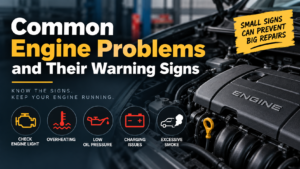
Ask whether the garage will pressure test the cooling system rather than simply replacing the most likely part. A pressure test finds leaks that aren’t visible when the engine is cold and stationary. Ask also whether the coolant used matches your manufacturer’s specification, since the wrong formulation creates problems months later that look unrelated to the original repair. Overheating is frequently a symptom of a broader issue, which is covered further in the article on common engine problems and their warning signs.
Book a Cooling System Check With Mechanic Bournemouth
If your temperature gauge has been climbing, your heater is blowing cold, or you’ve spotted coolant under the car, get it looked at before it becomes a roadside stop. Mechanic Bournemouth will pressure test the system, identify the actual fault, and explain it in plain terms. Get in touch with the team to book at the Bournemouth workshop, or arrange the mobile service if the car isn’t safe to drive.