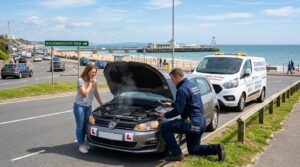
You bought a new battery six months ago. Or maybe it is only a year or two old. Either way, it keeps letting you down. You turn the key on a cold Bournemouth morning and hear nothing but silence. Or you get in on a Monday to find the car completely flat after sitting on the drive for the weekend.
Frustrating? Yes. Random? Almost never.
When a car battery keeps dying, the battery itself is often not the real problem. It is the symptom. Something else in the car is quietly killing it, and until you find the actual cause, every new battery you fit will end up in the same state.
At Mechanic Bournemouth, we diagnose repeat battery failures every week for drivers across Bournemouth, Poole, Christchurch, and Ringwood. In this guide, our IMI accredited technicians walk you through the eight hidden causes UK drivers miss most often, how to spot each one, and what to do about it.
Why “Just Replace the Battery” Is Rarely the Right Answer
Here is the mistake we see most often. A battery goes flat, someone jump starts the car, and eventually a new battery gets fitted. Two weeks later, the driver is back with the same problem.
A battery does not usually die on its own without warning. If yours keeps going flat, something is causing it to. That something might be an electrical fault, a bad driving pattern for your car’s needs, a charging system issue, or an accessory that is quietly drawing power in the background when you think the car is asleep.
Working through the eight causes below will help you narrow down which one is yours.
1. Something in the Car Is Not Going to Sleep
This is the number one hidden cause, and most drivers have never heard of it. When you lock your car and walk away, the electronics should gradually power down over the next twenty to thirty minutes and enter a low power sleep mode. In that state, the car should draw only a tiny amount of current, usually under 50 milliamps.
When something refuses to go to sleep, the drain can be many times higher. Over a night or two, that is enough to flatten even a healthy battery. Common culprits include:
- A body control module (BCM) or infotainment unit that stays partly awake
- A door lock, boot latch, or bonnet switch that does not register as fully closed
- A faulty relay stuck in the “on” position
- A software glitch after a recent update or repair
You will not see it happening. The car looks perfectly locked and quiet. The only clue is that the battery keeps going flat when the car has been standing. This is one of the most common jobs that comes into our workshop, and finding it requires a proper parasitic drain test with a professional multimeter. Our vehicle diagnostics service is specifically set up to trace these hidden drains.
2. Your Dashcam, Tracker, or Aftermarket Accessory Is Draining It
Modern accessories are wonderful until they are wired badly or configured incorrectly. The three biggest offenders we see are:
- Dashcams in parking mode. These stay recording when the car is off, drawing power from the battery. Without a proper low voltage cut off, they will happily run the battery flat overnight.
- Aftermarket trackers and alarms. A poorly installed tracker with no sleep function keeps pinging its location every few minutes, quietly bleeding the battery.
- Phone chargers left plugged in. Some 12V sockets stay live even when the ignition is off, and a phone or tablet on charge can drain the battery over a couple of days.
If your battery problems started after fitting a new gadget, that is your first suspect. Get the wiring checked, make sure a proper voltage cut off is in place, and unplug anything that is not essential before you park up for the weekend.
3. The Wrong Battery Was Fitted (or It Was Never Registered)
Modern cars are fussy about their batteries in ways older cars never were. If your vehicle has stop start technology or regenerative braking, it needs a specific type of battery, either AGM (Absorbent Glass Mat) or EFB (Enhanced Flooded Battery). Fit a standard lead acid battery in its place and it will not cope with the workload. It will fail early, sometimes within months.
Even fitting the correct type is only half the job on many newer vehicles. The car’s battery management system needs to be told a new battery has been installed so it can adjust its charging profile. This is called battery registration or coding, and it requires diagnostic equipment. Skip that step, and the alternator will either undercharge or overcharge the new battery, wearing it out fast.
If your battery was replaced recently and it still keeps going flat, this is a strong suspect. Our battery replacement service always includes fitting the correct type and registering it to your car’s ECU where required.
4. Corroded Terminals and (Especially) Bad Earth Straps
Everyone knows to look at the battery terminals for that white or blueish crusty buildup. What most drivers miss is the earth strap: the thick cable that runs from the negative terminal of the battery to the engine block or the car body. If that strap is corroded, loose, or damaged, the whole electrical system suffers.
You will get symptoms that look exactly like a weak battery. Slow cranking, dim lights, electrical faults, and repeated flat starts. The battery itself may test perfectly. In extreme cases, we have seen cars fail to start entirely because of a single corroded earth point that is a very quick fix once it has been identified.
Any thorough charging system diagnostic should check the earth straps as standard, not just the battery and alternator.
5. The Alternator Is Not Charging Properly (or Is Overcharging)
Your alternator is what keeps the battery topped up while the engine runs. If it fails or starts to under perform, no battery will hold charge for long. And if it starts to overcharge, the battery will boil off its electrolyte and fail even faster.
Signs that point to the alternator rather than the battery:
- The battery warning light appears on the dashboard while driving
- Headlights dim at idle and brighten when you rev the engine
- Electrical systems behave oddly (radio cutting out, wipers slowing, dashboard glitches)
- A jump start gets the car running but it dies again shortly after
- Your battery keeps going flat while you are driving, not just overnight
This is the classic misdiagnosis trap. A driver replaces the battery, then a week later the new battery is flat too. The real fault was always the alternator. Before any battery is fitted in our workshop, the alternator output is tested to make sure the charging system is doing its job.
6. Your Driving Pattern Is Silently Killing It
You do not think of your driving habits as a mechanical fault, but for modern cars they very much are. Every time you start the engine, the battery discharges a significant amount of energy. The alternator then needs enough drive time to put that energy back in, plus power everything else you are using (lights, wipers, heated screens, heated seats, blowers, infotainment).
If you only ever do short trips, the battery never fully recovers. It sits in a state of partial discharge, which shortens its life dramatically through a process called sulphation. Signs your driving pattern is the problem include:
- Most of your journeys are under fifteen or twenty minutes
- The car sits for several days between uses
- You use lots of accessories on those short trips (heated seats, defrosters, headlights)
- The battery started failing after a lifestyle change (working from home, retirement, new short commute)
The fix is not complicated. Take the car for a proper thirty to forty minute drive every week or two, ideally at motorway speeds. If that is not realistic for you, a smart battery maintainer plugged in overnight once a week will do the same job.
7. Extreme Temperatures Are Attacking It From Both Ends
Everyone knows cold weather is bad for batteries. What fewer people realise is that heat is even worse. British summers rarely hit truly punishing temperatures, but a car sitting in direct sun on a hot day can see under bonnet temperatures well over 60°C, and that heat accelerates the internal chemistry that ages a battery.
Cold, by contrast, does not really damage the battery. It just reduces the current the battery can deliver on demand. A weak battery that limped through summer will often fail on the first properly cold morning of the year, which is why UK breakdowns spike in November, December, and early January.
If your battery keeps going flat and it is more than three years old, weather is amplifying whatever else is going wrong. A pre winter battery health check is one of the smartest pieces of car care you can invest in. We include it as standard on our full and interim servicing.
8. The Battery Is Older Than You Think
Finally, the obvious one that drivers still miss. Most car batteries last three to five years. After the four year mark, they become significantly less reliable, even if the car still starts.
The trap is that batteries do not degrade at a steady rate. They can feel fine for months, then fall off a cliff over the space of a week. If yours is over three years old and it is starting to give you trouble, that is not “one of those things”, it is the battery telling you its time is up.
You can check the manufacture date stamped on the top or side of the battery case. If you cannot find it or you are not sure, a professional load test will tell you exactly how much life it has left. Do not wait for the no start morning.
How to Tell Which Cause Is Yours: A Quick Diagnostic Table
Not all flat batteries behave the same way. The pattern of when and how yours dies is a strong clue to the underlying cause:
| Symptom Pattern | Most Likely Cause |
| Flat every morning, even after a long drive the day before | Parasitic drain (something not sleeping), old battery |
| Flat after two or three days sitting on the drive | Dashcam, tracker, weak battery, or a module staying awake |
| Battery light appears while driving, headlights dim | Alternator or charging system fault |
| New battery keeps going flat within weeks | Wrong battery type, not registered to ECU, or hidden drain |
| Slow crank only on cold mornings | Battery approaching end of life, weakened by cold |
| Fine in summer, fails in November or December | Battery age plus cold weather amplification |
| Started after fitting a dashcam, tracker, or new stereo | Aftermarket accessory drain |
| Fine on long drives, fails after several short trips | Driving pattern not recharging the battery |
Match your pattern to the row that fits, and you have a strong starting point. From there, a proper diagnostic will confirm exactly what is going on.
What UK Garages Actually Check First
Here is the order any competent garage should work through when your battery keeps going flat. It matters, because doing these in the wrong order leads to a lot of unnecessary guesswork.
- Battery age and load test. How old is it, and how does it perform under real world load, not just resting voltage?
- Alternator output test. With the engine running, is the charging system producing between 13.7V and 14.7V?
- Terminal and earth strap inspection. Any corrosion, looseness, or damage on the positive terminal, negative terminal, or earth points?
- Battery type check. Is the fitted battery the right specification for the vehicle, and has it been registered where required?
- Parasitic drain test. With the car locked and all systems asleep, how much current is being drawn?
- Accessory audit. Are there any aftermarket dashcams, trackers, alarms, or chargers involved?
- Driving pattern review. How is the vehicle actually being used?
If your garage is skipping steps and going straight to a battery replacement, the problem is very likely to come back. If you would like a proper systematic diagnosis, our vehicle diagnostics team in Bournemouth can work through the whole checklist in a single visit.
When Enough Is Enough: Time to Book a Professional Check
If any of these apply, do not put it off any longer:
- You have needed a jump start more than once in the last month
- Your battery is less than a year old and already failing
- The battery warning light has appeared on your dashboard
- You have recently fitted a new dashcam, tracker, or stereo
- Your car sits for several days at a time and always starts weak
- You are heading into winter and are not confident your battery will make it
At Mechanic Bournemouth, our IMI accredited technicians run full battery and charging system diagnostics, trace hidden parasitic drains, and supply and fit the correct replacement battery (including AGM and EFB for stop start vehicles) with proper ECU registration.
If you cannot get to us, our mobile battery and diagnostic service covers Bournemouth, Poole, Christchurch, Ringwood, and the wider Dorset area, so we can come to your home, workplace, or roadside and get to the root of the problem where the car is.
If you would like to read more on the topic, our detailed guides on how to know if your car battery needs replacing before it fails and the most common car battery problems and their solutions are good next reads.
Frequently Asked Questions
Why does my car battery keep dying overnight?
The most likely cause is a parasitic drain: something in the car is still drawing current when it should be asleep. Common culprits are dashcams in parking mode, aftermarket trackers, boot or glovebox lights that stay on, and control modules that fail to enter sleep mode.
Can a bad alternator drain my battery?
Yes. If the alternator is not producing enough voltage while the engine runs, the battery will slowly deplete as it powers the car’s systems instead of being recharged. In some cases, a failing alternator diode can also allow current to flow backwards from the battery, draining it while parked.
Why does my new battery keep going flat?
There are four common reasons: an underlying fault (usually the alternator or a parasitic drain) that was never fixed, the wrong battery type for your vehicle, the new battery not being registered to the car’s ECU, or a hidden accessory drain.
How do I know if it is the battery or the alternator?
If a jump start gets the car running but it dies as soon as you disconnect the leads, the alternator is the more likely suspect. If a jump start gets it running and it keeps running fine, but the battery is dead again the next day, the battery itself is probably at fault. A professional test will confirm either way.
Can short journeys really flatten my battery?
Yes. Starting the engine draws a large burst of current from the battery, and short trips may not give the alternator enough time to replace it. Repeated over weeks and months, this leaves the battery in a permanently partial state of charge, shortening its life significantly.
Should I just keep jump starting it?
No. Repeated jump starting is a short term fix that hides the underlying cause and can stress modern car electronics. If you have needed to jump start your car more than once, the battery and charging system need to be tested properly.
Do electric and hybrid cars have this problem too?
Yes. Every hybrid and electric vehicle still has a small 12V auxiliary battery for the onboard electronics, and it can go flat for exactly the same reasons as a standard car battery. Hybrids that sit unused for a week or two are particularly vulnerable.