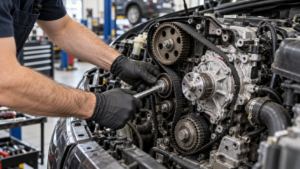
A snapped timing belt is one of the few faults that can turn a routine drive into a five figure repair bill in the space of a second. Despite this, it remains one of the most overlooked parts of the engine, tucked away out of sight and rarely thought about until something goes wrong. If you are asking yourself when your timing belt needs replacing, this guide covers everything a UK driver needs to know, from what the belt actually does, to the warning signs of failure, to how often manufacturers recommend changing it.
What Is a Timing Belt?
A timing belt, also called a cambelt, is a reinforced rubber belt found in most internal combustion engines. Its job is to keep the crankshaft and camshaft rotating in perfect sync. The crankshaft moves the pistons up and down, while the camshaft opens and closes the engine’s valves at exactly the right moment during each intake and exhaust stroke. If these two components fall out of sync, even by a fraction of a second, the engine cannot run properly and, in many cases, will suffer serious internal damage.
The belt itself is toothed on the inside so it grips corresponding teeth on the crankshaft and camshaft gears, much like a bicycle chain grips a sprocket. This toothed design stops the belt slipping, which is essential given how precisely engine timing needs to be maintained.
Timing Belt vs Timing Chain
Not every car uses a timing belt. Some engines use a timing chain instead, which does the same job but is made of metal rather than rubber. Timing chains sit inside the engine and are lubricated by the engine oil, which generally allows them to last much longer, often for the life of the vehicle. Timing belts, on the other hand, usually sit outside the engine and are not oil lubricated, which means the rubber compound gradually hardens and degrades with age and mileage.
A newer development is the wet belt, used by some manufacturers including certain Ford and PSA engines. Wet belts run inside the engine and are bathed in oil like a chain, yet they are still made of rubber composite material. This means they still need replacing at set intervals, and using the wrong grade of engine oil can cause them to break down prematurely.
To find out whether your car has a belt or a chain, check your owner’s handbook or ask a qualified mechanic to confirm during a service or diagnostic check.
When Should You Replace Your Timing Belt?
There is no single mileage figure that applies to every car, since the correct interval depends heavily on the make, model, engine size and age of the vehicle. As a general rule, most manufacturers recommend replacing the timing belt somewhere between 40,000 and 100,000 miles, or every four to ten years, whichever comes first.
Lower mileage drivers should pay particular attention to the time based interval rather than relying purely on mileage. Rubber degrades with age regardless of how many miles the car has covered, so a car that has only done 20,000 miles in eight years can still be at risk of a worn or perished belt.
The only reliable way to know your exact interval is to check your vehicle’s handbook or service schedule, or ask a mechanic to look up the manufacturer’s specification for your specific engine code. Because this figure varies so much between vehicles, guessing based on a friend’s car or a general rule of thumb is not a safe approach.
If you are unsure when your timing belt was last changed, particularly on a used car, our team can check your service history and vehicle specification as part of a full or interim service and advise whether a replacement is due.
Signs Your Timing Belt May Need Replacing
Timing belts are notoriously difficult to monitor because they often show few, if any, warning signs before they fail. That said, there are some symptoms worth acting on immediately.
- Ticking or rubbing noises from the engine. A rubbing or slapping sound coming from the belt cover area can indicate the belt is wearing unevenly or starting to fray. Any unusual engine noise should be checked straight away rather than left to worsen.
- Engine misfires or rough running. If the belt has stretched or slipped a tooth, the valve timing will be thrown off, which often shows up as a misfire, hesitation, or a noticeable drop in performance.
- The engine won’t start or turns over strangely. If the belt has snapped completely, the camshaft will stop turning even though the crankshaft is still spinning. This usually means the engine will not start at all, or it will crank without firing.
- Visible wear on the belt. If the belt is accessible, look for cracking, fraying, shiny patches, missing teeth, or oil contamination on the surface. Any of these are a clear sign the belt is due for replacement.
- Oil leaks near the timing cover. A leaking crankshaft or camshaft seal can allow oil to contaminate the belt, causing it to degrade far faster than normal.
Because the belt sits deep within the engine, most of these signs are difficult for drivers to spot without specialist tools. A trained eye and the right diagnostic equipment make all the difference, which is why our vehicle diagnostics service is often the quickest way to confirm whether your timing belt is the cause of an underlying issue.
What Happens If a Timing Belt Breaks?
The consequences of a broken timing belt depend on whether your engine is what’s known as an interference engine or a non interference engine.
In an interference engine, the pistons and valves occupy the same physical space at different points in the rotation cycle. If the belt snaps, the camshaft stops moving the valves out of the way in time, and the pistons collide directly with them. This typically bends or snaps the valves, damages the pistons, and can crack the cylinder head, often resulting in a full engine rebuild or replacement.
In a non interference engine, there is enough clearance that the valves and pistons will not collide even if the timing is lost. While this type of engine is less likely to suffer catastrophic internal damage, a snapped belt will still leave you stranded with a car that will not run, and the engine may still need components replaced before it can be started again safely.
If the belt fails while you are driving, the engine can cut out suddenly, which may also affect power assisted steering and braking on some vehicles. For safety, it is important to pull over as soon as possible if you notice any warning signs of a failing belt rather than continuing your journey.
Should the Water Pump Be Replaced at the Same Time?
On many vehicles, the water pump is driven by the timing belt, and reaching it requires removing the same engine components needed to access the belt itself. Because of this, it is common practice to replace the water pump at the same time as the timing belt, even if the pump is not yet showing signs of wear. Water pumps do not usually need replacing as often as belts, but since the labour to access both parts overlaps so heavily, doing them together avoids paying for that same access twice down the line and reduces the risk of a pump failure damaging a brand new belt shortly after it has been fitted.
Your mechanic may also recommend replacing the tensioners, idler pulleys and auxiliary drive belt at the same time, since these components work alongside the timing belt and are usually included as part of a full timing belt kit.
Can You Replace a Timing Belt Yourself?
Timing belt replacement is not a job for the average DIY mechanic. It involves removing multiple engine components, aligning the crankshaft and camshaft to exact timing marks, and fitting the new belt under the correct tension before everything is reassembled. Getting any of this wrong, even by a single tooth on the gear, can cause the exact engine damage the replacement was meant to prevent.
Specialist tools are required to lock the engine in the correct position during the job, and the process typically takes several hours of careful, methodical work. Given how much is riding on getting it right, this is a job best left to a qualified mechanic with experience on your specific make and model.
How to Check If a Timing Belt Has Already Been Replaced
If you have recently bought a car and are unsure of its timing belt history, there are a few ways to find out. Check the service book and any paperwork provided with the sale for a record of the replacement date and mileage. If you bought the car from a dealership or previous owner, it is worth asking them directly whether they have any documentation. Many garages also apply a sticker under the bonnet noting the date and mileage of the last cambelt change, so it is worth having a mechanic take a look during your next service.
If there is no record at all and the car is approaching, or has already passed, the manufacturer’s recommended interval, it is safer to assume the belt has not been changed and have it inspected or replaced as a precaution.
How to Look After Your Timing Belt
While a timing belt cannot be maintained in the same way as an oil filter or set of brake pads, a few habits can help avoid premature failure. Keep up with your car’s oil and filter changes using the correct grade of oil, particularly if your vehicle uses a wet belt system, since the wrong oil can cause the belt material to break down early. Address any oil or coolant leaks near the timing cover as soon as they are noticed, since contamination is one of the fastest ways to degrade the rubber. Most importantly, stick to your manufacturer’s recommended replacement schedule rather than waiting for symptoms to appear, since a proactive change is always safer and less disruptive than an unexpected failure.
Frequently Asked Questions
Is it safe to go slightly over the recommended timing belt interval?
It is not advisable. The belt does not fail gradually in a predictable way, so pushing past the recommended mileage or age increases the risk of sudden failure with no warning.
How long does a timing belt replacement take?
This depends on the vehicle, since some engines are far more labour intensive to access than others. Your mechanic will be able to give you an accurate estimate once they know your car’s make, model and engine.
Does every car have a timing belt?
No. Many modern engines use a timing chain instead, and some hybrid systems are designed differently again. Check your handbook or ask a mechanic to confirm which system your car uses.
What is the difference between a cambelt and a timing belt?
Nothing. Cambelt and timing belt are two names for exactly the same component.
Book Your Timing Belt Inspection in Bournemouth
If you are unsure when your timing belt was last replaced, or you have noticed any of the warning signs covered above, do not wait for it to fail. Our IMI accredited team offers a professional cambelt change service for all makes and models across Bournemouth, Poole, Christchurch and the wider Dorset area, using quality parts fitted to manufacturer specification. Get in touch with our contact page to book an inspection, or explore our full range of automotive services to keep your car running safely for years to come.