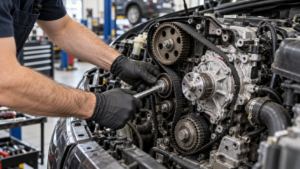
There is a hard truth that every mechanic sees week in and week out: the majority of major car repairs did not need to happen. They started as small, easily fixable problems that were missed simply because the car was not being serviced often enough.
A worn belt becomes a snapped timing chain. A dirty oil filter becomes an engine rebuild. A tired brake disc becomes a full braking system overhaul. Every one of these is preventable, and the difference between catching them early and being caught out is usually just one thing: a proper service, at the right time.
So how often should you actually be servicing your car? In this guide, our IMI accredited technicians at Mechanic Bournemouth break down exactly how frequently your vehicle needs professional attention, what each type of service covers, and the driving habits that mean you should be booking in more often than you think. Follow this advice and you will save yourself the stress, and the much bigger problem, of a breakdown you never saw coming.
How Often Should You Service Your Car?
The simple, industry standard answer is this: every 12 months or every 12,000 miles, whichever comes first.
That figure is the baseline recommended by most UK vehicle manufacturers, and it applies to the majority of petrol and diesel cars on the road today. If you drive more than average, or your car sees particularly demanding conditions, you should be servicing it more frequently than that.
Here is a quick reference guide to the standard UK service intervals:
| Service Type | Recommended Interval |
| Interim service | Every 6 months or 6,000 miles, whichever comes first |
| Full service | Every 12 months or 12,000 miles, whichever comes first |
| Major service | Every 24 months or 24,000 miles, whichever comes first |
| Manufacturer service | As set out in your vehicle handbook |
The most reliable way to find your car’s exact recommended schedule is to check your owner’s manual or your digital service record. If you cannot find it, your local garage can look it up for you. On modern vehicles with onboard computers, a service reminder will typically pop up on the dashboard when the next one is due. If you see it, do not ignore it.
The Different Types of Car Service Explained
Not every service is the same. Understanding the difference matters, because booking the wrong one can leave important checks undone.
Interim Service
An interim service is designed to catch small issues before they turn into bigger ones. It is ideal for drivers who cover higher mileage or use their car heavily, and it should be booked every six months or 6,000 miles between full services.
A typical interim service includes an engine oil and filter change, a top up of essential fluids (brake fluid, screen wash, coolant), a check of your lights, tyres, wiper blades, and brakes, and a broad safety inspection covering around 50 key points.
Think of it as a health check between the big annual services. It is the single best way to avoid unexpected problems between full services, especially for drivers who cover a lot of miles.
Full Service
A full service is the standard annual service most drivers should be booking at least once a year. It covers everything an interim service does, plus a much deeper inspection.
A typical full service includes changing the engine oil and oil filter, replacing the air filter, checking the fuel filter and spark plugs (or glow plugs on diesels), inspecting the battery and charging system, checking the brake pads and discs, examining the suspension and steering, testing the exhaust and emissions system, and running a diagnostic scan for any hidden fault codes.
If you only book one type of service a year, this is the one. Our full and interim servicing team in Bournemouth uses manufacturer approved parts and follows a comprehensive checklist so nothing gets missed.
Major Service
A major service is the most thorough option and is generally recommended every two years or 24,000 miles. It includes everything from a full service, plus additional items such as replacing the brake fluid, cabin (pollen) filter, and fuel filter, checking the gearbox oil, examining the drive belt and auxiliary belts, and inspecting external door hinges, locks, and other easily overlooked components.
A major service is where you catch the slow burning problems that a routine annual service is not designed to spot. It is particularly important for older cars, high mileage cars, and vehicles that have not had a major service in the last two years.
Manufacturer Service
If your car is still under warranty, you should also be aware of manufacturer service schedules. These are set by the vehicle’s maker and can vary significantly between models. A manufacturer service uses only original equipment parts and follows the maker’s exact specifications, which is often required to keep your warranty valid.
Even if your car is out of warranty, a garage that follows the manufacturer schedule closely will help protect your car’s resale value. Ask your mechanic to check your vehicle’s specific schedule when you book in.
How Missing a Service Turns Small Problems Into Big Repairs
This is the part most drivers underestimate. A service is not just a formality. It is a checkpoint that catches problems while they are still small and quick to fix. Skip one, and small problems have months to grow.
Here are the most common examples our technicians see every week:
- Dirty engine oil becomes engine damage. Oil breaks down over time and loses its ability to lubricate. If it is not changed at the right interval, metal parts start grinding against each other, wearing out bearings, pistons, and eventually the engine itself.
- A weak battery becomes a no start morning. Batteries lose capacity with age, and a service check spots a weak one before it fails. Miss the check, and you find out in a supermarket car park in January. If your battery is on its way out, we cover this in detail in our guide on how to know if your car battery needs replacing.
- Worn brake pads become damaged discs. Brake pads are meant to be replaced before they wear down to the metal. Left too long, they gouge the discs, which then also need replacing. A single missed service can double or triple the amount of brake work needed.
- A leaking coolant hose becomes a cracked head gasket. Small coolant leaks are easy to spot on a service. Ignored, they let the engine overheat, and a head gasket repair is one of the most involved jobs on any modern car.
- A slipping cambelt becomes catastrophic engine failure. Cambelts (timing belts) have a set life, usually somewhere between 60,000 and 100,000 miles. If yours is due and gets missed at a service, and it snaps while driving, the engine can be completely destroyed.
- A minor charging system fault becomes a dead alternator. Battery warning lights and low voltage readings picked up on a service diagnostic scan can be fixed for very little. Ignored, they leave you stranded and often destroy your battery in the process.
The pattern is always the same. A service catches the warning signs while the fix is still small. Skipping the service means those warning signs get missed, and the problem grows in the background until it becomes something serious.
Factors That Change How Often You Should Service
The 12 months or 12,000 miles rule is a baseline. Several driving habits and conditions mean your car needs more frequent attention than that.
- Lots of short trips. School runs, quick trips to the shops, and short commutes never let the engine reach full operating temperature. Oil degrades faster, moisture builds up inside the engine, and the battery never fully recharges. Short trip drivers should book an interim service every six months.
- High annual mileage. If you do more than 12,000 miles a year, you will hit the mileage trigger before the time trigger. Book based on whichever comes first.
- Coastal driving. Living near the sea, as many of our customers in Bournemouth, Poole, and Christchurch do, means your car is exposed to salt air year round. This accelerates rust on the undercarriage, brake components, and exhaust. Interim servicing is a smart insurance policy.
- Stop start city traffic. Constant idling and low speed driving puts far more strain on the engine, gearbox, and clutch than steady motorway driving. It also cycles stop start batteries far harder than manufacturers assume.
- Towing or heavy loads. If you regularly tow a trailer or carry heavy loads, everything from the brakes to the transmission works harder. Shorter intervals are essential.
- Older vehicles. Cars over about eight years old benefit from more frequent checks. Rubber components perish, seals dry out, and small leaks are common.
- Extended time sitting unused. Cars that sit for weeks at a time (second cars, campervans, weekend classics) suffer from flat batteries, fluid separation, and seized components. A pre use service is well worth the effort.
If any two or three of these apply to you, consider booking an interim service every six months and a full service every year. It is far easier to prevent problems than to fix them.
Warning Signs Your Car Needs a Service Sooner
Even if you are not yet due, book a service straight away if you notice any of these:
- A warning light on the dashboard that will not go off
- Squealing, grinding, or knocking noises when braking
- Vibration through the steering wheel
- A drop in fuel economy
- The engine feeling sluggish or unresponsive
- Any unusual smells, especially burning or something like rotten eggs
- Leaks of any colour underneath the car when parked
- Difficulty starting, particularly on cold mornings
- The car pulling to one side under braking
Any of these are signs that something is wearing out, breaking down, or already failing. Our vehicle diagnostics service in Bournemouth can pinpoint exactly what is causing the problem, often in a matter of minutes.
What About Low Mileage Cars?
A common misconception is that if you barely drive, you barely need a service. In reality, low mileage cars need servicing just as often as everyone else’s, and sometimes more.
Oil deteriorates over time as well as with use. Rubber components (belts, hoses, seals) perish with age regardless of miles. Batteries drain when the car sits unused. Brake discs and callipers can seize when they are not being exercised regularly. Fluids absorb moisture from the atmosphere and lose their protective properties.
The rule of thumb: even if you drive fewer than 6,000 miles a year, still book at least one full service every 12 months. Your car will thank you for it.
What About Electric and Hybrid Cars?
Electric vehicles and hybrids have fewer moving parts than traditional petrol or diesel cars, but they still need regular servicing. What changes is what a service covers.
For fully electric vehicles, a service will focus on the 12 volt auxiliary battery, brake system (which wears differently thanks to regenerative braking), tyres, suspension, cabin filter, coolant for the battery and motor systems, and a diagnostic scan of the high voltage battery and inverter.
For hybrids, servicing is essentially a mix of both worlds. The petrol or diesel side still needs oil changes and filter replacements, while the electric side needs its own dedicated checks. Hybrids are especially prone to 12 volt battery problems, so battery health is a key part of every service.
The service interval for both is broadly the same as for combustion vehicles: every 12 months, or as set out in the manufacturer’s schedule.
How to Prepare for Your Car Service
A little preparation makes your service faster and more thorough. Before you drop the car off:
- Bring your locking wheel nut key. Without it, the technician cannot remove the wheels to inspect brakes, suspension, and steering properly.
- Clear out the boot and cabin. This lets the technician access the spare wheel, tool kit, and any interior panels that need lifting.
- Bring your service book or digital service record. A full history helps the technician spot patterns and know what was last done.
- Note down any concerns. Weird noises, warning lights, or things that just do not feel right. The more information you can share, the faster your mechanic can get to the root of anything unusual.
- Fill up on fuel if it is running low. Diagnostic and road test checks need a reasonable amount in the tank.
The more organised you are, the more time the technician can spend actually working on your car, rather than trying to gain access to it.
Why a Full Service History Matters
Beyond preventing repairs, keeping a full service history is one of the smartest habits you can build as a car owner. When it comes time to sell or trade in your vehicle, a documented service record makes a significant difference to how easily it moves and how much confidence buyers have in it.
A car with a full service history sells faster, holds its value better, and gives the buyer confidence. A car with gaps in its history raises red flags. Dealers are far less enthusiastic about part exchanges with missing service records, and private buyers may walk away entirely.
Every service we complete at Mechanic Bournemouth is recorded, stamped where a physical service book is present, and logged digitally so you always have a clean, verifiable history to hand.
Book Your Service With a Team You Can Trust
If your car is due for a service, or if you have been putting one off, now is the time to book it in. Every month that passes without a service is another month for small problems to grow into large ones.
At Mechanic Bournemouth, our IMI accredited technicians offer interim, full, and major servicing for petrol, diesel, hybrid, and electric vehicles across Bournemouth, Poole, Christchurch, and Ringwood. We use quality parts, keep our checklists comprehensive, and always give you a clear, honest explanation of what your car needs (and what it does not).
We also run a mobile mechanic service across the Dorset area, so if you cannot get to us, we can come to your home or workplace and carry out most servicing tasks on the spot.
Ready to book? Get in touch today or call us on +44 7739 393911 for a straightforward, honest quote and a service you can trust.
Frequently Asked Questions
How often should I service my car if I hardly drive?
Even low mileage cars should have a full service every 12 months. Oil, fluids, and rubber components degrade with time as well as use, and battery problems are actually more common in cars that sit unused for long periods.
What happens if I skip a service?
Small, easily fixed problems have months to grow into large, complicated ones. Missed oil changes damage engines, worn brake pads damage discs, and small leaks turn into major failures. Skipping a service almost always ends up being far more of a hassle in the long run.
Do I need a service and an MOT?
Yes. They are two separate things. An MOT is a legal safety and emissions test required by law. A service is a proactive health check designed to catch problems before they cause failures. Passing your MOT does not mean your car is in good mechanical condition, and vice versa.
How long does a car service take?
An interim service typically takes around 90 minutes. A full service takes around three hours. A major service takes around four hours. If additional work is needed, it may take longer, but most services are completed the same day.
Does servicing my car affect its resale value?
Absolutely. A car with a full, documented service history holds its value far better at trade in or private sale than one with gaps in its history. It is one of the first things buyers and dealers look for.
Can I service my car myself?
You can carry out basic tasks such as topping up screen wash and checking tyre pressures. However, a proper interim, full, or major service requires professional equipment, diagnostic tools, and access to manufacturer procedures. Doing it yourself also breaks the paper trail that protects your resale value.
Does my car really need a service if there are no warning lights?
Yes. By the time a warning light appears, the fault is already causing problems. A service is designed to catch things before they trigger warning lights, when they are still small and easy to put right.