Most drivers only think about diagnostics once a warning light appears on the dashboard. It feels logical: no light, no problem. Yet many faults develop quietly long before the onboard computer decides to alert you, and by the time a light does appear, the issue may already be more advanced than it needed to be.
So the real question is this: can a diagnostic test actually catch something your dashboard hasn’t warned you about yet? The short answer is yes. Here is exactly how that works, what a diagnostic test can and cannot reveal, and how to tell when your car is due a check even if every light on the dash is off.
What Actually Happens During a Car Diagnostic Test
A diagnostic test involves connecting your vehicle to specialised equipment that communicates directly with the car’s Engine Control Unit (ECU), the onboard computer that constantly monitors sensors across the engine, transmission, brakes, airbags and other electronic systems.
Throughout normal driving, the ECU is quietly gathering data from dozens of sensors. When something falls outside its expected range, it stores that information as a Diagnostic Trouble Code, commonly known as a DTC. During a diagnostic test, a technician retrieves those codes along with live sensor data to build a picture of:
- Which system or component is affected
- How severe the issue is
- What might be causing it
- Whether the fault is current or historical
This process gives a technician a genuine head start compared to relying on a visual inspection alone, because many of these faults never produce anything you could see or feel while driving.
Do You Need a Warning Light for a Diagnostic Test to Be Useful?
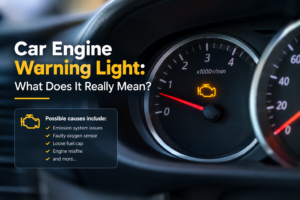
No, and this is the part most drivers get wrong. A warning light is simply the ECU’s way of telling you it has detected something serious enough to flag immediately. It does not mean every issue lights up straight away. Plenty of faults sit quietly in the system, either because they are still developing, only happen occasionally, or fall just under the threshold that triggers a dashboard alert.
If your car feels slightly sluggish, is drinking more fuel than usual, hesitates when changing gear, or simply doesn’t feel like itself, a diagnostic test can pick up on stored or developing fault codes that haven’t yet earned a spot on your dashboard. This is also why a diagnostic check is worth booking after buying a used car. It gives you a clear read on the vehicle’s history and current condition before any hidden issue becomes your problem.
What a Diagnostic Test Can Detect
A full diagnostic scan covers far more than the engine. Depending on the equipment used, it can uncover issues across the following systems.
Engine Performance Issues
Misfires, faulty sensors, poor fuel mixture and other issues affecting power, efficiency and emissions are often picked up here, even in the early stages before you notice any real change in how the car drives.
Battery and Charging Faults
A diagnostic test can reveal whether the battery, alternator or wider charging system is underperforming, which is one of the most common causes of starting trouble and unexpected power loss.
Braking System Problems
Faults with ABS sensors, brake pressure or communication between braking modules can be found before they ever affect how the car actually stops. If your brakes feel less confident than usual, it is worth pairing a diagnostic check with a proper brake inspection.
Transmission and Gearbox Concerns
Slipping gears, delayed shifts or sensor faults within an automatic gearbox can all be identified through diagnostics long before the problem becomes obvious behind the wheel.
Exhaust and Emissions Faults
Lambda sensors, NOx sensors and exhaust gas temperature sensors constantly feed information back to the ECU. A diagnostic scan can catch problems here that are quietly affecting fuel economy and emissions performance. This is closely tied to the health of your exhaust and emission system, so any recurring fault codes in this area are worth acting on promptly.
Airbag and Safety System Errors
Faults with airbags, crash sensors or seatbelt tensioners can be flagged well before you would ever notice anything wrong, which matters enormously given what these systems are there to protect.
Steering and Suspension Electronics
Physical wear still needs a hands on inspection, but the electronic side of power steering and suspension systems, particularly on vehicles with digital sensors, can be checked through diagnostics. If a fault points toward the suspension, it is a good moment to book a closer look with a suspension and shock absorber inspection.
Electrical System Malfunctions
Failing modules, wiring faults and miscommunication between systems often show up as strange, intermittent behaviour. A diagnostic scan can trace these back to their source rather than leaving you guessing.
What a Diagnostic Test Cannot Tell You
It is worth being honest about the limits here too, because a diagnostic test is a powerful tool, not a complete answer on its own.
Codes point to symptoms, not always the root cause. A misfire code, for example, tells you a misfire is happening, not whether the culprit is a spark plug, an ignition coil, an injector or a wiring issue. Interpreting that data properly is where an experienced technician makes the real difference.
Not every fault produces a code. Mechanical wear, such as a tired suspension bush or a worn clutch, generally will not trigger anything on a scan because it is not something the ECU monitors electronically. These issues still need a physical, hands on inspection.
Intermittent faults can hide. A problem that only appears occasionally, such as an electrical fault that comes and goes, may not show up unless it happens to be active at the exact moment of testing.
Equipment quality matters. A basic code reader will usually only access engine related codes. Professional grade diagnostic equipment can interrogate every module in the car, including ABS, airbags, transmission and steering systems, giving a much fuller picture.
Skilled interpretation is essential. Two cars can throw the same fault code for completely different reasons. Reading the result correctly, cross checking it against live data, and knowing which tests to run next is what separates a proper diagnosis from a guess.
This is exactly why a professional diagnostic service, backed by full system scanning and an experienced technician, tends to catch things that a quick code read at a parts shop will miss entirely.
Signs You Should Book a Diagnostic Test, Warning Light or Not
You do not need to wait for a light to appear. Consider booking a check if you notice any of the following:
- The car feels less responsive or sluggish than usual
- Fuel economy has dropped without an obvious reason
- Gear changes feel hesitant, jerky or delayed
- You hear new noises, whether that is knocking, whining or clicking
- The engine idles unevenly or stalls occasionally
- You have recently bought a used car and want peace of mind about its condition
- It has simply been a while since the car was last checked over
How Often Should You Get a Diagnostic Test?
As a general guide, an annual diagnostic check is a sensible habit, ideally alongside your routine full or interim service. If something feels off at any point in between, there is no need to wait. Booking a check as soon as you notice a change gives a technician the best chance of catching a small issue before it turns into a bigger, more disruptive repair.
Diagnostic scanning also pairs well with other routine maintenance. For instance, if your car is due an oil and filter change or a cambelt change, it is worth having a full system scan run at the same time so nothing gets missed while the car is already booked in.
Why Professional Diagnostics Make the Difference
A diagnostic test is only as good as the equipment behind it and the person interpreting the results. At Mechanic Bournemouth, our team uses the latest OBD equipment to run a full system scan across your vehicle, not just a basic engine check, and we explain every fault code in plain English rather than leaving you with a printout full of jargon.
Because we work on all makes and models across Bournemouth, Poole, Christchurch and the wider Dorset area, we see the same patterns again and again, which means we can usually tell you not just what a code means, but what is genuinely worth fixing first. Learn more about our vehicle diagnostic services or take a look at our full range of automotive services to see how a diagnostic check fits alongside the rest of your car’s maintenance.
Frequently Asked Questions
Can a diagnostic test find a fault even if no warning light has come on?
Yes. Many faults are stored in the ECU’s memory or develop gradually without ever triggering a dashboard light. A diagnostic scan can reveal these before they become noticeable while driving.
Will a diagnostic test fix the problem?
No. A diagnostic test identifies and confirms the issue. Repairs are then carried out separately based on what the scan and a technician’s inspection reveal.
Is it worth running a diagnostic check on a car I am about to buy?
Absolutely. It is one of the simplest ways to understand the true condition of a used car before you commit, and it can highlight issues that a visual inspection alone would miss.
Can a diagnostic test detect mechanical wear, like a worn suspension component?
Not directly. Diagnostics are excellent at picking up electronic and sensor related faults, but mechanical wear generally requires a physical, hands on inspection to confirm.
Book Your Diagnostic Check in Bournemouth
Whether your dashboard is lit up or your car simply doesn’t feel quite right, it is always worth getting a professional opinion rather than waiting to see what happens. Our team is ready to run a full diagnostic scan, explain exactly what it means, and recommend the right next step for your vehicle. Get in touch with Mechanic Bournemouth today to book your appointment.