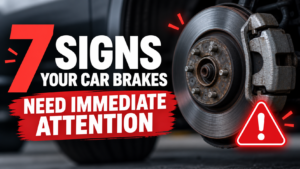
Your brakes are the single most important safety system on your car. Every other component can fail and you might still limp home safely, but a serious brake fault can turn a normal drive into an emergency in seconds. The tricky part is that brake wear rarely happens overnight. It creeps up gradually through everyday driving around Bournemouth, Poole and Christchurch, which means many drivers only notice a problem once it has already become dangerous or expensive.
This guide walks through the seven clearest warning signs that your brakes need urgent attention, why each one happens, and what you should do the moment you notice it. If any of these sound familiar, book a brake inspection and repair with our Bournemouth team as soon as possible.
Key takeaways
- Squealing, grinding, a spongy pedal and vibration are usually the first noticeable signs of brake wear.
- A dashboard warning light, a burning smell or a noticeably longer stopping distance should never be ignored.
- Catching a problem early often means a simple pad change rather than a full disc and calliper replacement.
- Short, stop start journeys around Bournemouth wear brakes faster than longer motorway drives, so local drivers should be extra vigilant.
Why brake wear matters more than you think
Bournemouth’s town centre traffic, seafront congestion and school run routes all put brakes through repeated heavy use. Every time you brake, friction material is worn away and heat builds up in the discs. Over months and years this wear is normal, but once it passes a certain point, stopping power drops off quickly rather than gradually. That is why so many drivers describe brake failure as sudden, when in reality the warning signs had been there for weeks. Knowing what to listen and feel for gives you time to act before a routine repair becomes a safety incident.
1. Squealing or grinding noises when you brake
A high pitched squeal when you press the pedal is usually the first sign your brake pads are wearing thin. Most pads include a small metal wear indicator that is designed to make contact with the disc and squeak once the friction material has worn down to a certain thickness. It is essentially an early warning system built into the pad itself.
If that squeal turns into a harsher grinding sound, the situation has become more serious. Grinding usually means the friction material is completely gone and metal is now scraping directly against the brake disc. This causes damage every single time you brake, and it can quickly turn an affordable pad replacement into a much larger repair involving discs as well.
In Bournemouth’s stop start traffic around the town centre and seafront, pads often wear faster than the mileage alone would suggest. If you notice any new noise from your brakes, it is worth having them checked sooner rather than later.
2. A soft or spongy brake pedal
If the brake pedal sinks lower than usual or feels soft and spongy underfoot, the issue is most likely in the hydraulic system rather than the pads themselves. Common causes include air trapped in the brake lines, a fluid leak somewhere in the system, or brake fluid that has absorbed moisture over time and lost its effectiveness.
A healthy brake pedal should feel firm and responsive within the first inch or two of travel. A spongy pedal is a clear sign that hydraulic pressure is not being delivered properly to the callipers, and this type of fault can worsen suddenly rather than gradually. It should be treated as urgent. A brake fluid check, bleed or full renewal usually restores a firm, confident pedal feel.
3. Vibration through the pedal or steering wheel
A pulsing or juddering sensation felt through the brake pedal, and sometimes through the steering wheel as well, usually points to warped or unevenly worn brake discs. Discs can distort after repeated heat build up from heavy braking, particularly on longer descents or during sustained hard braking in traffic. Once a disc is no longer perfectly flat, the pad grips an uneven surface and sends that vibration straight back through the car.
You are most likely to notice this when braking from higher speeds, such as slowing down from the A338 or A35. In some cases a slightly warped disc can be resurfaced, but discs that are badly distorted usually need replacing in pairs to keep the braking force balanced across the axle. A proper measurement during an inspection will confirm which option your car needs.
4. Your car pulls to one side when braking
If your car veers noticeably to the left or right every time you brake, it means the two sides of the braking system are not gripping equally. Typical causes include a sticking calliper, uneven pad wear from one wheel to another, a seized slider pin, or a partial fluid problem affecting a single wheel.
This is a genuinely unsettling fault because it forces you to correct your steering mid stop, right at the moment you need full control of the car. It is especially dangerous in wet weather or heavy traffic. Because the cause can vary from wheel to wheel, a full inspection is really the only reliable way to identify which component is sticking or worn, and the earlier this is fixed, the less uneven wear it causes elsewhere in the system.
5. Longer stopping distances than normal
If your car seems to take longer to come to a stop than it used to, your braking system is losing effectiveness somewhere. Worn pads, glazed discs, contaminated fluid or a slow fluid leak can all reduce stopping power. This is one of the most dangerous symptoms on this list because many drivers only notice it during an emergency stop, when there is no margin left for error.
Braking distance makes up the majority of your total stopping distance at speed, and wet or poor road conditions increase it significantly. Under the Highway Code, drivers are advised to at least double their following distance on wet roads and increase it up to ten times on icy roads, because a vehicle takes considerably longer to stop in those conditions. Worn brakes combined with a damp Dorset commute is a poor combination, so if stopping feels slower than usual, book an inspection rather than waiting to see if it gets worse.
6. The brake warning light on your dashboard
When a brake related warning light appears on your dashboard, your car is telling you something needs attention. Depending on the exact symbol, it could indicate low brake fluid, a worn pad sensor, a handbrake fault or an ABS system issue. None of these should be dismissed as a temporary glitch.
Start by checking that your handbrake is fully released, since a partly engaged handbrake can sometimes trigger the light. If the warning stays on, have the system scanned as soon as possible. Worn brake components are also one of the most common reasons vehicles fail their MOT, so a warning light left unaddressed can catch you out at test time as well as on the road. A routine full or interim service often picks up these faults before the warning light ever appears.
7. A burning smell after braking
A sharp, acrid smell after braking hard or descending a long hill usually means your brakes are overheating. Common causes include a calliper that is binding rather than releasing fully, a handbrake left slightly engaged, or riding the brake pedal continuously on a downhill stretch. Overheated brakes lose effectiveness, a condition known as brake fade, which means the pedal can feel firm while stopping power quietly disappears underneath you.
If you notice this smell, pull over safely as soon as you can and allow the brakes to cool before continuing. A faint smell after a steep hill can sometimes be normal, but a strong smell during ordinary driving is not, and visible smoke from a wheel means you should stop the car immediately. Persistent burning smells need professional attention before you drive any further.
How urgent is each brake symptom
Not every symptom on this list demands you pull over immediately, but several do. Grinding metal, a pedal that sinks toward the floor, smoke or a strong burning smell, and a red brake warning light should all be treated as urgent, meaning you should drive as little as possible and get help straight away. Squealing, mild vibration and a slightly longer stopping distance are pressing rather than an emergency, but they still deserve prompt attention.
A simple rule of thumb: anything that affects how your car actually stops, whether that is pedal feel, pulling to one side, or stopping distance, should be inspected within days rather than weeks. Brake faults rarely improve on their own, and early attention usually protects the more expensive components behind the pads, such as the discs and callipers. If you are ever in doubt, get it checked.
How our Bournemouth mechanics diagnose and fix brake problems
Every brake inspection at Mechanic Bournemouth starts with a full visual and physical check of the pads, discs, callipers, brake lines and fluid condition, followed by a road test where needed to confirm what you are feeling or hearing. We use OEM quality parts so your warranty stays intact, and we explain exactly what we find in plain English before any work begins.
Because brake issues are often linked to other systems, our technicians will also flag related concerns during the inspection. A car pulling to one side, for example, can sometimes point to a suspension or shock absorber issue rather than the brakes alone, while a persistent warning light is often best investigated with a full vehicle diagnostic scan to pinpoint the exact fault code. Looking at the whole picture, rather than just the symptom you called about, means fewer repeat visits and a safer car overall.
Frequently asked questions
How often should I get my brakes checked?
As a general guide, have your brakes inspected at least once a year or at every service, whichever comes first. If you drive mostly in heavy town traffic or notice any of the signs above, get them looked at sooner. Regular inspections catch wear early and keep future repairs smaller.
Can I keep driving with squealing brakes?
A short trip to the garage is usually fine, but do not ignore the noise. Squealing means the pads are running low. Once that noise turns to grinding, drive as little as safely possible, since metal on metal contact damages the discs and turns a routine pad change into a far bigger job.
Should brake pads and discs always be replaced together?
Not always. If the discs are still within their minimum thickness and free of scoring or warping, replacing just the pads is often enough. When discs are scored, warped or worn past tolerance, they should be replaced alongside the pads so the whole system performs evenly. A measurement during inspection will confirm exactly what your car needs.
How often should brake fluid be changed?
Most manufacturers recommend renewing brake fluid roughly every two years. Brake fluid is hygroscopic, meaning it gradually absorbs moisture from the air, and old, water laden fluid lowers the boiling point of the system and can make the pedal feel spongy under hard braking. This is why a fluid check forms part of a thorough brake service.
Why do my brakes feel fine but the warning light is on?
Brakes can feel completely normal while a sensor is already detecting low fluid or thin pads. The warning light is an early alert rather than proof that something has already failed. It is worth having the system scanned promptly rather than waiting for a symptom you can physically feel, since those usually only appear once the problem is more advanced.
Do short journeys wear brakes out faster?
Yes. Frequent stop start driving, such as school runs and short trips around town, wears pads and discs faster than steady motorway driving. Bournemouth’s town centre and seafront routes are a good example of the kind of driving that accelerates brake wear.
Book a brake inspection in Bournemouth today
Brake problems rarely fix themselves, and the earlier you catch one, the simpler and safer the repair tends to be. If you have noticed any of the seven signs above, whether it is a squeal, a spongy pedal, a vibration, or a warning light that will not switch off, our experienced team is ready to help. We serve drivers across Bournemouth, Poole, Christchurch and the wider Dorset area, including a convenient mobile mechanic service for when you cannot get to us.
Visit our brake repairs and replacement page to learn more about how we work, browse our full range of automotive services, or get in touch today to book your inspection. Your safety, and everyone else’s on the road, depends on brakes that are working exactly as they should.